johnston@mphc.co.za | Mon-Fri : 9:00 – 16:30


Midlands Poultry Health Centre has a fully equipped post mortem facility.
All Post mortem investigations are done here.
Post mortem samples are taken to the on-site laboratory for rapid and efficient processing.
Sample processing is rapid and efficient with the laboratory being next door to the PM room.
When birds are submitted for post mortem analysis the vets start with an overall external examination. This includes weight, evidence of trauma, soiling of feathers, vent damage, skin lesions, eye lesions, external parasites, foot pad lesions and joint swelling. Then they move to the internal examination which consists of the respiratory system, internal organs, gastrointestinal tract, air sacs and lungs, reproductive tract, bursa and thymus, proventriculus and gizzard, crop, oesophagus, brain, nerves, caecal tonsils, and leg quality (bones, joints, growth plates), evidence of internal parasites and more.
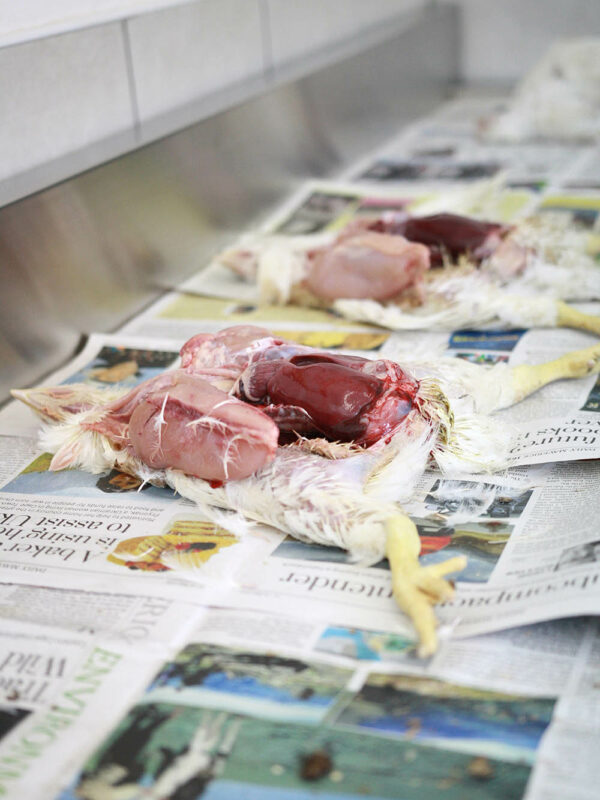

Sending birds for post-mortem analysis can help give vets an indication of what is wrong with the flock and how to proceed in fixing the problem.
For the vets to get a good understanding of what is going on, we need to effectively communicate how to submit the birds and have general background information about them.
We aim to take a deep look into the necroscopy of the chickens as well as understand how your farm operates to best help you individually.
Birds can be submitted either live or freshly deceased, or a combination of live and deceased (best option) to give us a better understanding of symptoms.
We ask for 5-10 adult birds or 10-20 chicks from the affected house(s). The vet will determine what samples should be submitted for laboratory analysis and a post-mortem document will be discussed/sent to describe the preliminary findings.
When the laboratory tests are completed, you will be sent the results with the vet’s interpretation of how to proceed. Feel free to contact Dr Johnston with any queries.
